A space assessed and brought up to standard today may have barriers tomorrow. Not necessarily because something was done badly or because something broke, but because the space changed, as every space changes over time.
This is one of the most important insights about accessibility, and one of the least practiced. The tendency is to treat compliance as a project with a beginning, a middle and an end.
The space changes. Accessibility has to keep up.
The corporate environment is dynamic by nature. Changes in working models, layout reconfigurations, team relocations and process revisions are all part of the continuous evolution of organizations. Each of these transformations, even a minor one, can affect how spaces are used and perceived.
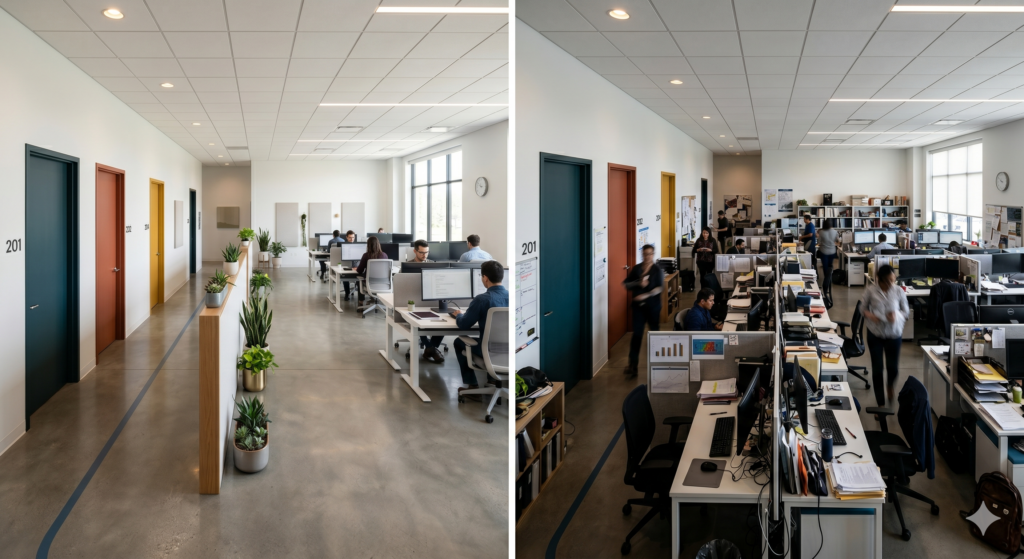
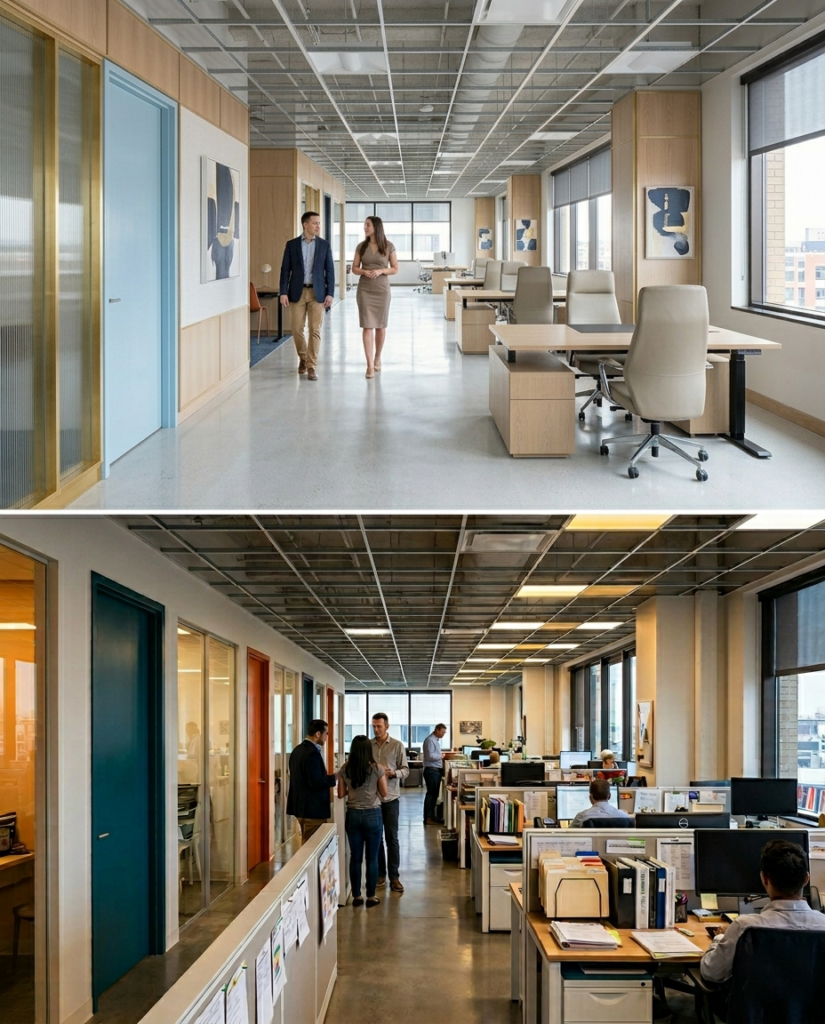
A refurbishment that opens up a new route that has never been assessed. A retrofit that alters the relationship between circulation and furniture. A layout reconfiguration that places an element where there used to be clear space. A temporary partition that becomes permanent without anyone checking whether the accessible route was preserved.
Technical standards change too
ABNT NBR 9050 and the other standards governing architectural accessibility in Brazil are living documents, revised periodically. A space designed and built in line with the current version of a standard may fall out of date when that standard is revised.
This does not mean the space became inadequate overnight. It means the reference benchmark has evolved, and that accessibility management needs to keep pace with those updates.
The profile of those who use the space also changes
A space that served the user profile of three years ago well may not serve the current profile with the same quality. An employee with a disability who recently joined the team brings specific requirements that were not within the scope of the original assessment.
Beyond the physical profile of users, the attitudinal profile of teams also changes over time. Employees who went through accessibility training leave and are replaced by people who never received it. If attitudinal accessibility is not built into the onboarding processes for new employees, the accumulated knowledge is gradually lost.
Upkeep as management, not as reaction
A loose grab bar, a deactivated alarm, worn signage, a burnt-out bulb. Each of these problems seems small when looked at in isolation. In the experience of those who use the space and depend on these features, they accumulate and turn what should be an autonomous journey into one full of uncertainty.
Maintaining safety features is part of accessibility management.
How the Maintenance Phase responds to this
The Guiaderodas Certification is structured in three phases: Pre-Certification, Certification Assessment and Maintenance. The Maintenance Phase exists precisely because accessibility does not end with certification.
Once certification is achieved, the site formally joins the Maintenance Phase, which follows the transformations of the environment and of the teams, keeps the space up to date with standards, legislation and best practice, and preserves the quality of the conditions achieved. The phase is continuous in nature, with annual renewal.
During this period, the site can submit its refurbishment, retrofit, layout change and use reconfiguration projects to the Guiaderodas architecture team for analysis, so as to ensure adherence to the applicable technical standards. This proximity guarantees accuracy in the interventions and avoids unnecessary spending and rework.
After five consecutive years of active maintenance and demonstrated progress, the site becomes eligible for the Guiaderodas Gold Certification, a recognition of the maturity and longevity of its commitment to accessibility.
Make accessibility a decision, not a detail
If accessibility is a process, it needs a management structure, not a one-off project.
The Guiaderodas Certification goes beyond a technical checklist. Its methodology combines a detailed assessment of the physical space, the lived experience of people with disabilities, staff training for an accessible attitude and a leadership commitment to continuous improvement.
Learn about the Guiaderodas Certification →