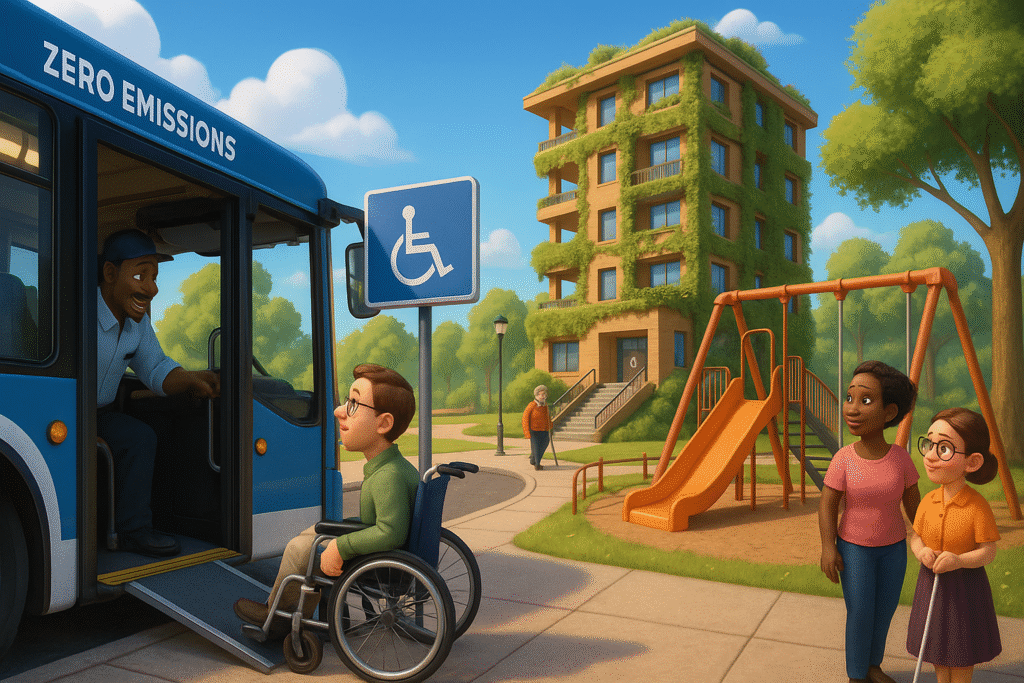
The word sustainability often evokes images of a preserved environment, clean energy and green cities. For a long time, the focus of sustainable development was almost exclusively on the environmental pillar. However, the modern understanding of sustainability has evolved to include social and human aspects too. In that broader context, accessibility, understood as guaranteeing equitable access to spaces, services and opportunities for people with disabilities or reduced mobility, emerges not as a parallel topic but as an integral part of sustainability. In other words, there is no genuinely sustainable future without inclusion.
To illustrate that connection, it is enough to recall the words of former UN Secretary-General Ban Ki-moon, who warned in 2012 that “accessibility is critical to achieving the future we want”. That statement reflects the view that accessibility, inclusion, diversity and sustainability are interlinked and interdependent concepts. Without them, we will not overcome the human and environmental challenges that threaten the planet’s future.
This article develops that integrated view, showing how sustainability and accessibility go together in building a fairer, more resilient and more sustainable future for everyone. We will cover the evolution of the concept of sustainability, the role of accessibility as “human sustainability”, its incorporation into policy and projects, practical examples across various sectors, mutual benefits, and the challenges and routes to making accessibility inseparable from sustainability agendas.
Sustainability beyond the environmental: social and human inclusion
Originally, sustainable development was described mainly in environmental terms. In the Brundtland Report (1987), for example, sustainability was defined as meeting present needs without compromising future generations, with an emphasis on environmental preservation. In recent decades, however, that concept has expanded into a three-pillar model: environmental, economic and social. Caring for ecosystems is not enough; social equity and improvement in human quality of life must also be guaranteed. Envisaging a sustainable world presupposes that everyone is actively included as protagonists of their own lives.
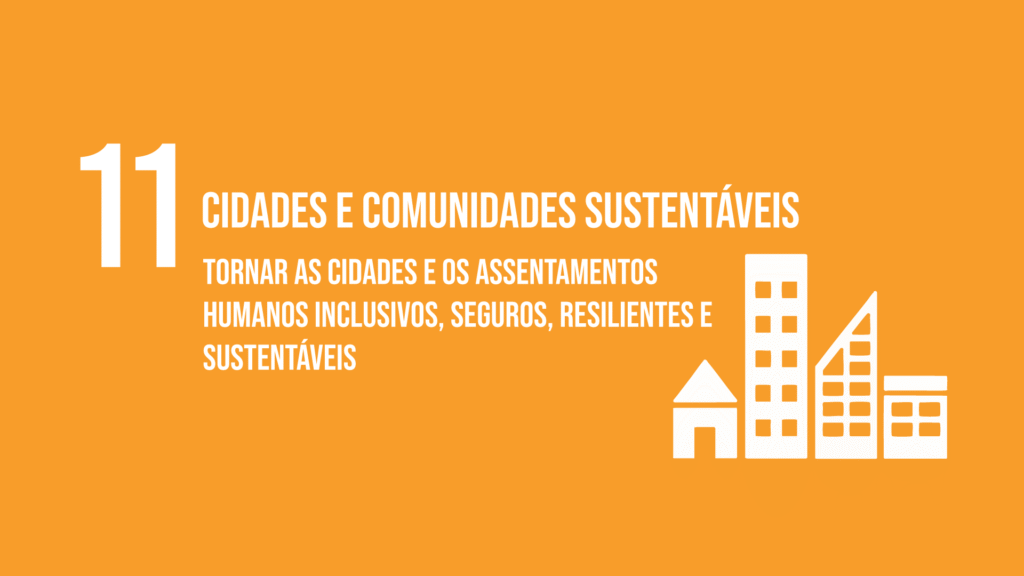
That evolution gained momentum in global agendas. The UN’s 2030 Agenda (launched in 2015), for instance, makes it clear that sustainable development must benefit everyone, committing to “leave no one behind”, a principle that recognizes the inclusion of vulnerable groups, including people with disabilities, as a cross-cutting issue. The Sustainable Development Goals (SDGs) reflect that broader vision. SDG 11, “Sustainable cities and communities”, explicitly sets out the objective of making cities and human settlements inclusive, safe, resilient and sustainable. Its targets include guaranteeing, by 2030, accessible public transport for all, with special attention to people with disabilities and older people, and universal access to safe, inclusive and accessible public spaces for women, children, older people and people with disabilities. These international commitments make clear that social inclusion lies at the very heart of sustainability. It is important to note that this integration of environmental and social agendas is not merely international rhetoric: it has also been endorsed at national level. In Brazil, for example, back in 2004 the then Minister of the Environment, Marina Silva, stated that “bringing together the challenge of development with social inclusion is the best stimulus for that to happen”. In other words, developing sustainably requires tackling ecological challenges and social inequalities together. In short, sustainability has evolved from an exclusively “green” agenda into a more human and complete paradigm, in which social justice, accessibility and diversity stand alongside environmental protection and balanced economic growth.
Accessibility as human sustainability
If sustainability seeks to secure a better future for coming generations, that implies including all people in the present. Accessibility refers to the conditions of reach, use and autonomous participation of any individual, including people with disabilities (physical, visual, hearing, intellectual) or reduced mobility, in every aspect of life in society. From the standpoint of sustainability, we can see accessibility as a form of human sustainability: it ensures that no part of the population is left out of development. It is therefore a fundamental human right and a collective duty. Building environments, products and services that everyone can use benefits society as a whole and makes our communities more resilient and just.
Today, the relevance of accessibility is undeniable in the numbers: according to the World Health Organization (WHO), around 15% of the world’s population lives with some form of disability. We are talking about a very significant share of humanity. Ignoring these people in development plans would mean compromising the promise to “leave no one behind”. Moreover, disability is inherent to human life: even someone with no disability today may acquire one temporarily or permanently over the course of their life, whether through accidents, illness or natural aging. The world’s population is aging rapidly. Between 2015 and 2050, the proportion of people over 60 will almost double, from 12% to 22%, and aging brings gradual motor and sensory limitations. This means that long-lived societies will need to be intrinsically more accessible. Planning for accessibility now means anticipating that reality and promoting demographic sustainability.
It is worth stressing that accessibility does not only benefit those who have a disability today: it creates conditions for universal well-being. When we guarantee curb ramps, adapted transport, clear communication and inclusive spaces, everyone benefits: pregnant women, older people, children, people with temporarily reduced mobility, and so on. This phenomenon is known as the “curb cut effect”: features initially conceived for people with disabilities end up benefiting a far larger group. A classic example is the sidewalk ramp, created for wheelchair users but also used by people with strollers, delivery workers with hand trucks, travelers with wheeled suitcases and even most of us day to day, without even noticing. Another example is closed captioning on video: developed for deaf or hard of hearing people, it is today used by millions of hearing people (whether to watch videos in silence or to understand dialogue in foreign languages). In other words, inclusion improves quality of life for everyone. In that sense, accessibility works as a catalyst for sustainable human development: by removing barriers, it enables more people to participate actively in the economy, cultural life, the labor market and community life, strengthening the social fabric. For all these reasons, accessibility must be seen as intrinsic to sustainability. These are not separate agendas but a single convergent one: genuine, human-centered sustainability requires equity and inclusion. Without accessibility, we risk perpetuating inequality and excluding millions of people from social and economic progress, which is not sustainable under any definition of the term. As one important Brazilian article summarized it, “accessibility represents the fourth fundamental pillar of truly sustainable societies”, alongside the traditional economic, social and environmental pillars.

Sustainable policies and projects with accessibility from the outset
If accessibility and sustainability go together, that union needs to begin with the conception of policies and projects. Including the accessibility perspective from the outset avoids future rework, reduces the cost of later adaptations and, above all, ensures that the benefits of sustainable projects reach everyone. Planning inclusively from the start is always more efficient than trying to “adapt” afterward.
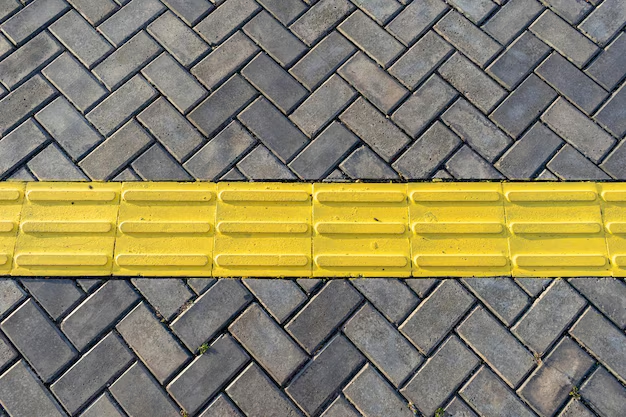
One of the key concepts here is Universal Design: the idea of designing environments, buildings, products and services that can be used by as many people as possible, regardless of physical or cognitive characteristics. For example, when developing a new “sustainable” square with ecological landscaping, accessible routes for wheelchair users, tactile paving for people with visual impairments, ergonomic benches for older people, rest areas and clear visual information should all be planned in from the start. The square will then be both sustainable and inclusive, fully serving its social function. Likewise, an ecologically sound building must also be an accessible building: including ramps or elevators from the architectural design stage, accessible restrooms on every floor, Braille signage in elevators and assistive technologies (such as audible and visual alarms) is part of genuinely sustainable architecture. Architectural sustainability is not only about using solar panels, but also about ensuring that everyone can enjoy that building safely and autonomously.
Current standards and legislation are already moving in that direction. In Brazil, the Brazilian Inclusion Act (LBI) and technical accessibility standards (such as ABNT’s NBR 9050) establish clear parameters for accessible construction, and compliance with these standards should be seen as an integral part of the sustainability criteria for buildings and cities.
Globally, the UN Convention on the Rights of Persons with Disabilities (ratified by more than 180 countries, including Brazil) obliges governments to ensure accessibility in physical environments, transport, information and communication (Article 9), and principles of accessibility and universal design also appear in documents such as the UN’s New Urban Agenda. Adopted at the Habitat III conference (2016), it emphasizes that inclusion and accessibility are preconditions for fully integrated and sustainable cities.
In other words, the goals of resilient and “smart” cities cannot be achieved without considering the needs of all citizens from the outset, especially those in vulnerable situations.
Integrating accessibility into public policy also means social participation in planning. It is fundamental to involve people with disabilities, older people and other minority groups in the development of urban and environmental projects. After all, no one is better placed than the users themselves to indicate which barriers need removing and which solutions work best. Participatory processes and inclusive public consultation help create more effective projects. We now speak of “nothing about us without us” in the context of urban and environmental planning: sustainable urban mobility plans, for example, need to listen to wheelchair users, blind people and others in order genuinely to design transport systems that are efficient and usable by all.
An inclusive sustainable policy covers everything from details, such as installing audible traffic signals in cities (making crossing easier for blind people and bringing more safety to all pedestrians), to broad questions, such as ensuring that social housing programs include units adaptable for residents with disabilities or reduced mobility. It also means assessing new renewable energy, green infrastructure or climate mitigation projects through the lens of accessibility: for example, an off-grid community environmental education center needs to be physically accessible; a natural disaster warning system (for floods, say) must have multiple communication channels, sirens, SMS, sign language in videos, in order to reach people with different needs. Community resilience depends on everyone being informed and able to act in emergencies. The Intergovernmental Panel on Climate Change (IPCC), in its most recent report, noted that populations with disabilities are among the most vulnerable to extreme weather events, precisely because of barriers in access to information, transport and emergency shelters. Adapting our cities to climate change therefore necessarily involves making them more accessible and inclusive, ensuring that no one is left behind in risk situations.
In short, incorporating accessibility from the start into urban, environmental, corporate and technological policy is an irreversible path toward achieving sustainability goals in full. Successful sustainable projects today are those that are born universal, designed for human diversity. Below, we will look at practical examples in different areas, from architecture and urban mobility to events, companies and technologies, showing how initiatives that unite sustainability and accessibility bring concrete gains for society.
Practical examples: integrating accessibility and sustainability
The connection between sustainability and accessibility can be seen in practice across various sectors. Below are examples in architecture, urban mobility, events, technology and business, illustrating how integrated projects produce positive and inspiring results.
Architecture and urban spaces: universal design and cities for everyone
An example of inclusive leisure: adapted play equipment in a park allows children who use wheelchairs to enjoy the swings too, demonstrating universal design in public spaces.
Sustainable architecture is not only about energy efficiency and ecological materials: it also involves concern for universal accessibility. Increasingly, architects and urban planners adopt “universal architecture” solutions that combine low environmental impact with high positive social impact. A good project seeks to harmonize aesthetics, ecological functionality and inclusion.
In cities, we see “green” parks and squares emerging with adapted equipment: gentle ramps replace staircases where possible; slip-resistant and tactile surfaces guide people with visual impairments; children’s playground equipment gains accessible versions (such as wheelchair swings, as in the image above); sensory gardens are designed with plants of different scents and textures, appealing to people with visual impairments and to the general public alike. These welcoming and accessible spaces invite the whole community to enjoy nature and leisure, reinforcing social cohesion.
One example is the Praças da Cidadania (Citizenship Squares) project in a number of Brazilian cities, which regenerates degraded areas by creating accessible community gardens, comfortable benches with armrests (making it easier for older people to sit down and stand up) and wide paths suitable for wheelchairs and strollers, reconciling environmental sustainability (more green space, rainwater management) with inclusion.
On a global scale, Singapore is frequently cited as a benchmark in urban accessibility integrated into planning. Faced with its rapidly aging population, the city-state applies rigorous universal design principles in new buildings and public spaces. The guidelines include, for example: spaces free of structural obstacles, lowered service counters, handrails on both sides of stairs, adapted seating in waiting areas, Braille signage and audible devices in buildings. As a result, practically every new building in Singapore is born accessible. The outcome? Tourists and residents report that the city is one of the most accessible in the world, which also brings economic returns, since it attracts more visitors and allows people of all ages to move around and spend with ease.
In short, a sustainable city must be an inclusive city: safe, walkable streets for everyone, level and tree-lined sidewalks, adequate lighting including for people with low vision, barrier-free public buildings and an urban ambience that welcomes all.
It is worth remembering that adapting existing buildings is possible (and necessary), but far more expensive and complex than designing correctly from the start. That is why sustainable building policies now already include accessibility criteria. Many sustainable construction certifications (such as LEED, AQUA and others) are beginning to recognize aspects of well-being and inclusion as part of a project’s overall quality. In São Paulo, a competition run by the city government to innovate in bus shelters was won by the architecture practice Estúdio Módulo, which developed an accessible and sustainable street furniture model, with solar power for lighting and information in Braille for users with visual impairments, as well as a reserved space for wheelchair users to wait comfortably for the bus. This example shows practical integration: ecologically responsible design (solar lighting and durable materials) combined with accessibility (a platform at the correct height, tactile signage). The result serves the population better and makes public transport more inviting, contributing both to social inclusion and to reduced emissions (since more people can choose public transport).
Urban mobility: sustainable and equitable transport
In the field of urban mobility, accessibility is a key element of social and environmental sustainability. Cities that invest in sustainable public transport (such as subways, light rail and electric buses) will only realize the full potential of those systems if they are accessible to all users. That means having adapted stations and stops, vehicles with easy boarding and accessible information. It is no coincidence that SDG target 11.2 focuses precisely on providing safe, accessible and sustainable transport, with attention to people with disabilities and older people. Inclusive transport generates more passengers, reduces dependence on private cars and, consequently, cuts congestion and polluting gas emissions: a clear mutual benefit between accessibility and environmental sustainability.
Several cities around the world have set an example. Curitiba, a pioneer of BRT (Bus Rapid Transit) in Brazil, has since the 1980s included tube stations with raised platforms level with the bus entrance, greatly easing access for wheelchair users and people with mobility difficulties (with no need to climb steps). Today, other BRT systems and sustainable bus corridors across the country follow that practice. In São Paulo, the urban bus fleet has lifts or access ramps and reserved space for wheelchairs, mandatory measures that came from accessibility legislation and that converge with the goal of sustainable transport. Accessible trains and subways (with elevators in stations, tactile paving, and audible and visual announcements) allow more people to choose mass transit over the car. In other words, an inclusive transport system increases uptake and improves environmental impact by carrying more people efficiently.
Walking is also transformed when we look at it through the lens of accessibility. Sidewalks are the city’s most basic and democratic infrastructure, provided they are well maintained and accessible. Sustainable sidewalk programs must include curb ramps at corners, well-marked crosswalks and adequate signal timing for older people to cross calmly. Walkable cities are healthier and less polluting, because they encourage people to walk. But no one will choose to walk if the sidewalks are full of holes or obstacles. Investing in accessible sidewalks and safe walking routes is therefore both an act of inclusion (benefiting wheelchair users, people with visual impairments and others) and an act of sustainability (encouraging active mobility, which cuts emissions and improves public health). The curb cut effect mentioned earlier illustrates this well: on implementing sidewalk ramps for inclusion, it was discovered that the whole city gains smoother mobility. In addition, technology has been an ally in making urban mobility smarter and more inclusive. Accessible routing apps are emerging: Google Maps, for example, has incorporated the option of “wheelchair accessible” routes, indicating paths and public transport equipped for people with reduced mobility.
Cities such as Seattle, in the United States, have gone further and developed specific maps (such as AccessMap) that provide detailed information about street gradients, sidewalks and obstacles, helping those with mobility difficulties to plan flat and safe routes. These digital resources increase the confidence and autonomy of people with disabilities in using urban infrastructure, integrating them into the city’s sustainable flows.
In short, sustainable urban mobility requires accessibility: low-floor electric buses, bike lanes designed also for adapted tricycles, ecologically draining sidewalks that are nonetheless barrier-free, smart traffic signals that detect slower crossings, and so on. The result is cities with more balanced traffic, less pollution and a more active population, where everyone, from a young person to an older person with a walker, can get around. That is the vision of a genuinely sustainable city: clean in its air and soil, and inclusive in its streets

Sustainable and inclusive events: culture accessible to all
When we think of sustainable events, what comes to mind is usually waste reduction, recycling, carbon offsetting and the like. But the social dimension of sustainability in events is equally important. Making an event accessible and inclusive means allowing people of all backgrounds and abilities to take part in and enjoy the cultural, sporting or corporate activities on offer. And this goes hand in hand with environmental objectives: after all, events are held by and for people, and the more diverse the people engaged, the greater the event’s positive social impact.
Several recent initiatives show how these concerns can be united. Music festivals, for example, are already adopting social inclusion policies as part of their sustainability planning. This ranges from infrastructure measures, such as access ramps, adapted restrooms, reserved parking spaces and Braille menus in food courts, to affirmative actions, such as distributing free tickets to people on low incomes or with disabilities (promoting equity in access to culture).
An inspiring case took place in Brasília: the CoMA Festival 2022, in addition to implementing various accessibility adjustments at the venue, ran a dedicated selection process and hired 80 professionals with disabilities to work on the event’s production and operation. These roles covered a range of functions (customer service, logistics, box office, photography and others), showing that inclusion also means providing employment opportunities and visibility. The success of this initiative demonstrates that inclusion is both feasible and enriching: the festival gained a diverse and capable team, and the workers with disabilities gained training and experience in the cultural market.
Beyond the social aspect, accessible events tend to be well regarded by audiences and sponsors, improving reputation and reach. Sporting events such as the Olympic and Paralympic Games, for example, already develop integrated plans: temporary facilities are built to be accessible, volunteers receive training in serving people with disabilities, and all visual and audio communication is designed to be universal (announcements with captions, clear signage and so on).
In the corporate sphere, many “green” conferences now offer sign language interpretation, menu options for people with allergies (an example of inclusion of another kind), quiet spaces for autistic people or those with sensory sensitivities, among other measures, recognizing that the diversity of participants is part of the sustainability of the knowledge shared there.
Indeed, ISO 20121, the international standard for sustainable event management, covers not only environmental criteria but also provides guidance on considering accessibility and inclusion as part of an event’s positive legacy. An event is sustainable when it minimizes negative environmental and social impacts and maximizes positive ones.
So, in replacing disposable cups with reusable ones and introducing separate waste collection (a positive ecological impact), the conscientious organizer will also ensure that people with visual impairments can find the waste bins through adequate signage, or that people with reduced mobility can reach those same disposal points. No detail is too small: from stage to audience, everything must be considered. And the reward is a richer event: inclusion broadens the audience (more people can and want to take part), improves everyone’s experience and sets an educational example.
In summary, whether it is a music festival, a trade fair, a conference or a community celebration, sustainability and accessibility must go together in event organization. This ensures that the event’s legacy is not only a low volume of waste or offset emissions, but also positive memories and opportunities experienced by people of every profile. A genuinely sustainable event is also welcoming and democratic, reflecting on a small scale the society we are seeking in the future.

Innovation and assistive technology: accessibility driving modernity
Technology plays a dual role in the relationship between sustainability and accessibility. On one hand, technological innovation can offer powerful tools for inclusion; on the other, ensuring that digital technology itself is accessible is both a challenge and a part of sustainability in the contemporary world (since digital exclusion deepens inequality). Fortunately, we are seeing encouraging advances in assistive technology and inclusive digital design, often driven by this vision of human sustainability.
Assistive technology in action: a musician in a wheelchair uses voice-controlled home automation to manage the lighting while playing guitar, demonstrating how technological innovation expands autonomy and inclusion.
In recent years, technology giants and startups have developed solutions that empower people with disabilities, enabling their active participation in the economy and in society, which is fundamental to inclusive development. For example, the popularization of voice assistants and smart homes (Alexa, Google Home and others) has brought direct benefits: people with limited mobility can control lights, appliances and doors by voice command, gaining independence at home (as illustrated in the image above). This not only improves individual quality of life but can also reduce energy consumption (since automation optimizes the use of electrical appliances), uniting inclusion and environmental sustainability.
Another field is that of high-technology prostheses and orthoses, many now produced with more sustainable materials (such as bioplastics) and through 3D printing, which reduces waste. Powered exoskeletons allow people with paraplegia to walk, increasing their mobility and health. Alternative communication technologies (for example, tablets with specialized software) give a voice to people with speech disabilities.
By integrating these innovations, smart cities can become more responsive: imagine public transport that communicates with a blind user’s device to warn them that their stop is approaching, or traffic signals that automatically activate audible signals on detecting someone with a white cane at the corner. These scenarios are already being tested in smart cities around the world, contributing to SDG 11 and also to SDG 9 (Industry, Innovation and Infrastructure).
It is important to stress that digital accessibility is itself a front of struggle. With the expansion of online services, from digital banking to telemedicine, from remote learning to e-commerce, ensuring that websites and apps are accessible is crucial. This is part of sustainability in the sense of building an information society that does not exclude. Screen reading tools for blind users, captions and sign language windows in videos for deaf users, keyboard-navigable interfaces for those who cannot use a mouse, color and font choices that consider people with color blindness or dyslexia: all of these are web and mobile development practices guided by Inclusive Design. Companies that incorporate these criteria are not only complying with legislation (such as Brazil’s electronic government accessibility decree), but also expanding their market reach and demonstrating ESG (Environmental, Social and Governance) commitment on the social dimension.
Inclusive technology also generates economic and innovation benefits for companies. In seeking solutions to serve people with disabilities, companies often create better products for everyone. One example is the predictive virtual keyboard (which suggests words as you type): initially conceived to help people with motor disabilities write with less effort, it is today a standard feature that speeds up typing for any smartphone user. From a business standpoint, adopting accessibility as a core value differentiates a brand, expands the market and stimulates creativity in the creation of products and services. Reports show that there are more than one billion consumers worldwide with some form of disability, a significant and frequently underserved market. Meeting that demand is both an opportunity and a social contribution.
Technological innovation and accessibility therefore reinforce one another. A genuinely sustainable innovation ecosystem seeks solutions that address the population’s real problems, above all those of the most vulnerable groups. And in doing so, it often discovers more efficient and sustainable ways of operating. For example, developing lighter and more accessible software also makes it less demanding on hardware, saving energy. Creating devices to help older people live independently for longer (fall sensors, health monitoring) can reduce the burden on health systems and the emissions associated with frequent trips to hospital.
The synergies are many. What matters is holding on to the vision that technology in the service of people, of all people, is a pillar of a sustainable future.

Companies and inclusive sustainability: corporate social responsibility
In the corporate world, it is no longer enough for companies to adopt responsible environmental policies; a commitment to diversity and inclusion is also expected, including accessibility for employees, customers and the community. That is the heart of the Social pillar of the ESG concept. Leading companies have been showing that including accessibility in their sustainability strategy brings tangible benefits both to society and to the business.
One fundamental aspect is creating accessible and inclusive workplaces. This involves adapting physical infrastructure (offices with accessible routes, adapted restrooms, ergonomic workstations), but also organizational culture: guaranteeing employment opportunities for people with disabilities, running training and awareness programs for colleagues and leaders, and providing accessibility resources (assistive technologies, sign language interpreters at important meetings and so on).
When a company enables a talented person with a disability to work to their full potential, it is promoting sustainable development in the social sense (reducing inequality, in line with SDG 10). And there are internal gains: studies indicate that diverse teams are more creative and productive.
Many corporations report innovation driven by inclusion. In meeting the needs of an employee or customer with a disability, a process or product improvement that benefits everyone is frequently discovered. For example, a company that makes its annual report accessible in digital format for screen readers ends up producing clearer, better-organized material for any investor. Or a factory that adapts machines with visual and audible indicators for the safety of deaf employees discovers that this reduces accidents for all operators. This search for accessible solutions stimulates creativity and improves overall quality.
From a market standpoint, embracing accessibility expands the consumer base. Retail companies that adapt their stores (physical and online) to welcome customers with different needs broaden their reach. Banks that invest in digital accessibility build loyalty not only among customers with visual impairments but also among many older people who benefit from friendlier interfaces. Accessibility thus becomes a competitive differentiator. In addition, institutional image benefits: the brand is seen as ethical and concerned with social well-being, which adds intangible value and consumer preference.
There are various recognized initiatives in this field. Some companies adopt inclusive hiring policies, reserving percentages of positions or forming partnerships to train people with disabilities. Others invest in community projects, such as sponsoring the construction of accessible parks or developing rehabilitation technologies, aligning social responsibility with their core business. One interesting example is a multinational hygiene products company that, in promoting sustainable basic sanitation in low-income communities (installing ecological toilets), included wheelchair-accessible facilities in the project, showing that even in environmental philanthropy, inclusion has to be considered.
Finally, it is worth noting that governments and regulators are demanding more of companies on this agenda. Sustainability reports now tend to address accessibility (for example, how many manufacturing facilities are accessible, the percentage of employees with disabilities and so on) within the social pillar. In Brazil, the Quota Law requires medium and large companies to hire people with disabilities, and the LBI provides for fines for venues of collective use that are not accessible. In other words, beyond the moral duty, there are legal and economic incentives to embed accessibility once and for all in corporate sustainability commitments.
Inclusive companies build inclusive societies. When the private sector, the engine of the economy, integrates accessibility, it drives a chain of change: suppliers adapt, competitors follow the example, customers become more aware. Accessibility thereby ceases to be an isolated topic and comes to permeate the entire development ecosystem. That integrated vision is undoubtedly part of the sustainable future we aspire to, in which economic growth goes hand in hand with social justice.

Mutual benefits: how accessibility strengthens sustainability (and vice versa)
Having gone through these examples, it becomes clear that accessibility and sustainability reinforce one another. Let us highlight some of the reciprocal benefits and synergies of this integration:
- Full realization of sustainable investment: Environmental or urban projects reach their full potential when they are accessible. An urban park will only fulfill its sustainable role of improving quality of life if everyone can enjoy it. Without accessibility, investments made in solar energy, recycling or sustainable landscaping may fail to benefit important segments of the population (such as older people and people with disabilities), reducing the expected positive social impact.
- Greater uptake and public engagement: Sustainable initiatives that take diversity into account attract more public support. For example, a door-to-door recycling program that trains waste collectors with disabilities or hires people with Down syndrome as environmental educators not only includes those who are often excluded from the labor market, but also inspires the community to take part. The message conveyed is one of solidarity and respect, values that encourage engagement. Inclusion can therefore increase the success of environmental programs.
- Expanded innovation and creativity: As we have seen, in seeking to meet accessibility requirements, innovative solutions are found that frequently improve processes for everyone. That effect spreads: universal designs in sustainable products tend to be more versatile; accessible information systems tend to be clearer and more efficient. Sustainability gains from products and services that are better conceived and tested for a range of uses.
- Multiplier effect in the community: Accessibility has an enabling effect. When a person with a disability gains access to quality education, transport and employment, they are able to contribute still more to society, economically and socially. Through inclusion, we gain more active citizens. That strengthens social cohesion and the local economy, making the community more prosperous and better able to invest in environmental and social improvements. Inclusion therefore generates community resilience and the human resources to carry sustainable projects forward.
- Indirect environmental benefits: Some accessibility measures help the environment. For example, accessible remote work and distance learning (with adapted platforms) allow more people (including those with disabilities) to work or study from home, reducing travel and the corresponding carbon emissions. More walkable cities with accessible public transport take cars off the streets, improving air quality. Even greater participation by people with disabilities in public discussion can bring new perspectives to inclusive environmental solutions, such as thinking about accessible climate shelters during disasters, which increases the effectiveness of resilience plans.
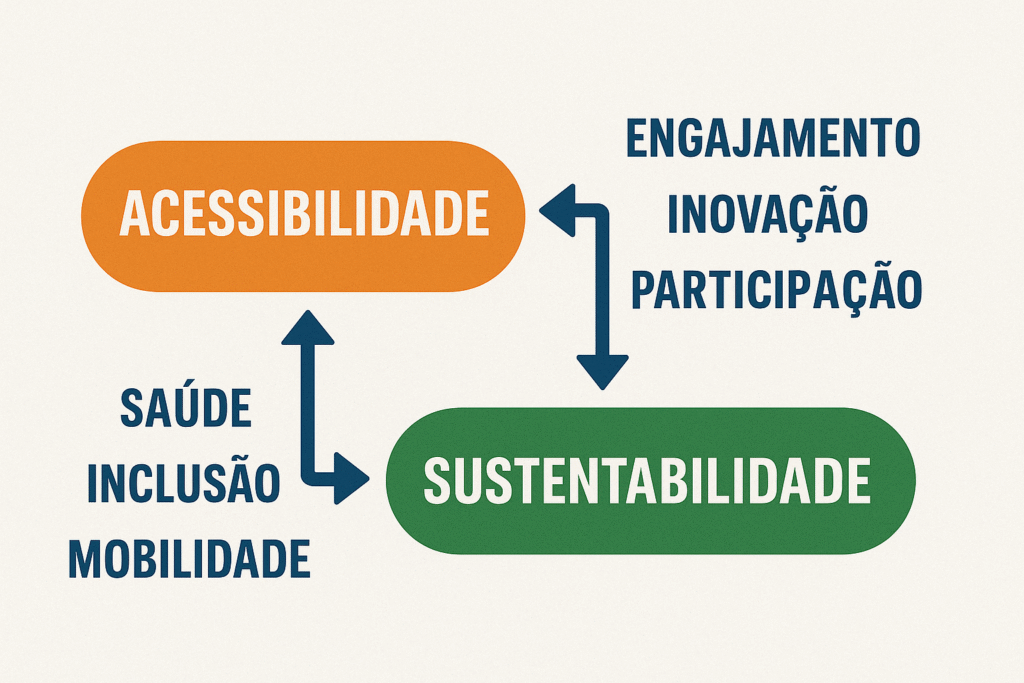
In short, sustainability and accessibility form a virtuous circle. Accessibility strengthens the social pillar of sustainability, guaranteeing equity and justice, without which sustainability is left lame. Sustainable projects, in turn, offer the opportunity to include more people in their benefits, improving human development indicators. As Ban Ki-moon aptly summarized, “without accessibility we will not achieve the future we want”, and the reverse also holds: with accessibility, we bring that future, at once more inclusive and more sustainable, closer to reality.
Challenges and routes to an integrated agenda
Despite the growing consensus on the importance of uniting accessibility and sustainability, considerable challenges remain in making that integration a standard and global practice. Identifying these obstacles is the first step to overcoming them. Below, we discuss some of the main challenges and point to routes for consolidating accessibility as an inseparable part of sustainability commitments from here on:
- Infrastructure and historical legacy: Many cities and buildings were constructed at a time when accessibility was not considered. The backlog of inaccessibility is enormous: narrow sidewalks, public buildings full of stairs, old public transport with no adaptation. Updating that infrastructure demands investment and planning. The challenge is to prioritize resources for the most urgent adaptations (hospitals, schools, transport stations) while continuing to invest in new construction that is accessible from the start. Government retrofit and urban improvement programs need to include accessibility as a criterion. One route is to tie financing and green certifications to proof of accessibility: for example, granting tax incentives or sustainability seals only to buildings and spaces that are also inclusive.
- Awareness and technical capability: Although the idea of inclusion is more widespread, many sectors still lack technical knowledge about how to implement accessibility. Professionals in architecture, urban planning, engineering, design and IT do not always receive adequate training in universal design. This results in well-intentioned projects that fail in practice (ramps that are too steep, websites with inadequate contrast and so on). It is fundamental to incorporate accessibility content into academic curricula and to offer continuing professional development. International and national organizations have produced best-practice manuals, such as ISO 21542 (accessibility in construction) or the W3C guidelines for web accessibility, but these need to reach the front line. Education and training are clear routes: certifying architects in accessibility, training public officials, and making managers aware of the importance of consulting universal design specialists during projects.
- Fragmented sectoral vision: Sustainability is often treated in silos (environmental separate from social). In companies, for example, the environmental responsibility team may not talk to the diversity and inclusion team. In governments, environment departments and departments for the rights of people with disabilities work in isolation. That lack of a cross-cutting approach can cause projects to miss synergies. The route here is to institutionalize integration: creating interdisciplinary working groups that think about policy holistically, including accessibility criteria in all tenders for sustainable projects, and fostering academic research that unites the themes (such as “accessibility and climate change” or “inclusion and circular design”). The subject then ceases to belong to “two agendas” and becomes a single shared one.
- Perception of cost and lack of priority: A frequent obstacle is the mistaken notion that accessibility greatly increases project costs or is “unfeasible” in certain contexts. In fact, many accessibility features carry a low cost if planned from the outset, sometimes representing less than 1% of a construction budget. Moreover, the cost of non-accessibility is rarely measured: social exclusion, litigation (lawsuits over the lack of accessibility), the need for rework to adapt, accidents and health problems caused by barriers all generate greater expense in the long run. Decision-makers need to be made aware that accessibility is an investment, not an expense. Including social impact indicators in the return calculations for sustainable projects can help make the added value visible. Public incentive and award policies are also routes forward: for example, sustainable architecture competitions that reward the most inclusive projects, or green credit lines with lower interest rates for developments that exceed minimum accessibility requirements.
- Insufficient participation and empowerment: People with disabilities and other beneficiary groups still have limited participation in decision-making processes. Solutions are often designed for them rather than with them. This can lead to poorly targeted or underused measures. The challenge is to guarantee effective channels of social participation: active municipal councils, accessible public hearings (with sign language interpreters, materials in accessible formats, accessible venues), online consultations that are usable by everyone. Inclusive activism also needs to connect with the environmental agenda, and vice versa. Youth climate movements, for example, can include people with disabilities in their leadership, bringing new perspectives (such as that of someone who suffers greatly from heat islands because they depend on a wheelchair in cities with no tree cover). Strengthening alliances between environmental NGOs and disability organizations can generate joint progress. The result will be more robust policy and greater social legitimacy for action.
- Updating standards and indicators: Finally, one structural route is to update technical standards, building codes and sustainability indicators to fully incorporate accessibility. Many green certifications still do not award points for social or accessibility criteria. That is changing, but it could be accelerated. Urban sustainability indices (such as smart or sustainable city indices) should include inclusion metrics (percentage of accessible transport, degree of sidewalk adequacy and so on). When we begin to measure and rank cities and projects by their accessibility too, an additional stimulus for continuous improvement is created. Official bodies such as IBGE, IPEA and government ministries could produce periodic reports on “inclusive sustainability”, monitoring progress on these combined fronts: for example, how many Brazilian municipalities already have master plans that address universal accessibility, or what percentage of companies report ESG inclusion indicators. Data of that kind guides policy and makes it possible to demand progress.
In summary, the challenges exist and are not few, but the routes to overcoming them are in sight. They require political commitment, a change in professional mindset, resource allocation and public engagement. What matters is recognizing that accessibility is not an appendix but an integral part of the solution for complete sustainable development. The obstacles should be confronted not with a sense of obligation or burden, but with the conviction that by making our environments more inclusive we are building a better future for everyone, including for ourselves and our loved ones, since accessibility supports us at every stage of life.usive para nós mesmos e nossos entes queridos, já que a acessibilidade nos acolhe em todas as fases da vida.
A sustainable future is necessarily inclusive
Sustainability and accessibility are not competing or parallel agendas: they are two sides of the same coin, two paths leading to the same desired future. An environmentally balanced planet, with green cities and clean technologies, is worth little if barriers persist within it that exclude millions of people from the opportunity to live with dignity and participate fully. Conversely, an inclusive and accessible society will prosper still more in a healthy environment with preserved natural resources. The vision of the future must encompass both: a world that is greener and more human at the same time.
Throughout this text, we have seen that integrating accessibility expands the impact of sustainable initiatives, generating additional social, economic and even environmental benefits. We have also seen that policies and projects conceived with that inclusive perspective have a greater chance of success and durability. To include is to innovate; to include is to sustain: to sustain cohesive communities, to sustain development across generations, to sustain the hope of a better future shared by all.
There is a saying in the disability movement: “nothing about us without us”. We can extend that principle to sustainability as a whole. The future of the planet cannot be planned without considering all the peoples and persons who inhabit it. Just as we speak of preserving biodiversity in nature, we need to value human diversity in society. Rethinking sustainability with a more human, inclusive and accessible perspective is not merely desirable: it is necessary if the objectives set out in global agreements such as the 2030 Agenda are to be fully achieved.
The good news is that every step in that direction generates a positive cascade. Every ramp installed, every piece of information made accessible, every inclusive policy approved builds a piece of that shared future. And all of us can contribute: governments, companies, organizations and citizens. Whether by demanding accessibility in local construction, supporting brands committed to inclusion, or simply showing empathy and offering help when we come across someone facing a barrier, these attitudes reinforce a culture of inclusion.
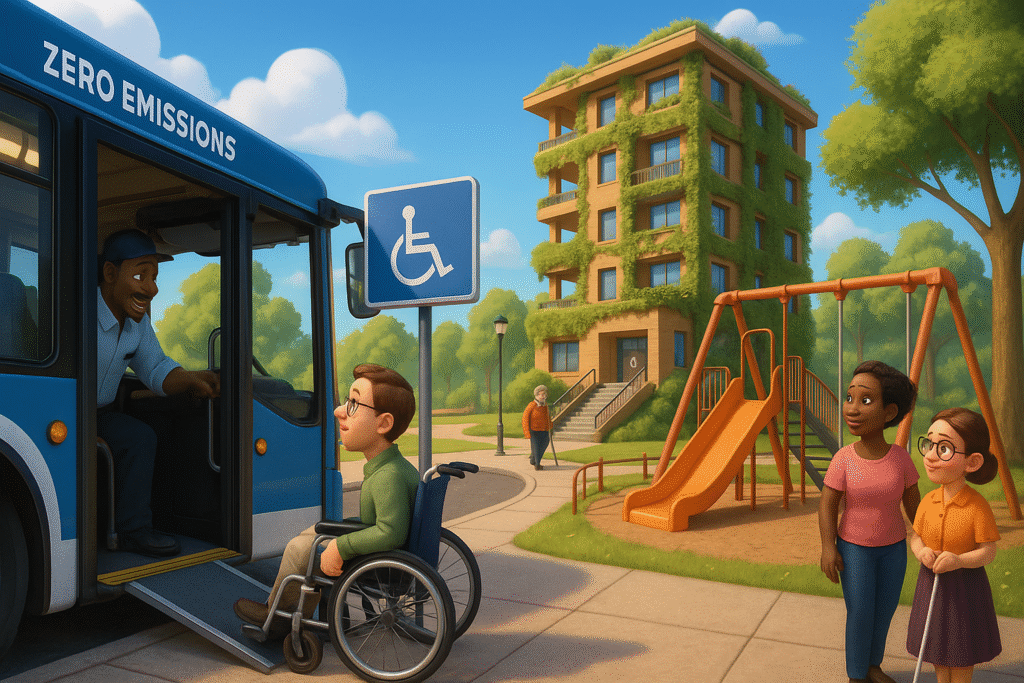
On a not-too-distant horizon, we can imagine our cities as fairer and more resilient, where quiet, non-polluting buses carry passengers of all ages and abilities; where urban parks serve as meeting points for children with and without disabilities to play together; where smart buildings adjust to each user’s needs; where cultural events celebrate the diversity of their audiences; and where technological innovation serves those who need it most, amplifying voices previously silenced. That scenario is not utopian: it is being built, project by project, policy by policy, around the world. May that vision serve as our inspiration and motivation. Sustainability and accessibility united point to a genuinely sustainable future for everyone, a future in which development and inclusion go hand in hand. As individuals and as a society, we are invited to embrace this cause with optimism and concrete action. The future we want, green, inclusive, accessible and prosperous, depends on the choices and commitments we make today. Together, by aligning these two agendas into one, we will be taking a decisive step toward “one and the same future”: one in which every human being has a place, a turn and a voice on a planet in balance. Let us press on, building that future without leaving anyone behind.
Make accessibility a decision, not a detail
The social pillar of ESG needs evidence, not intention. That is what a certification provides.
The Guiaderodas Certification goes beyond a technical checklist. Its methodology combines a detailed assessment of the physical space, the lived experience of people with disabilities, staff training for an accessible attitude and a leadership commitment to continuous improvement.
Learn about the Guiaderodas Certification →