
What is Universal Design?
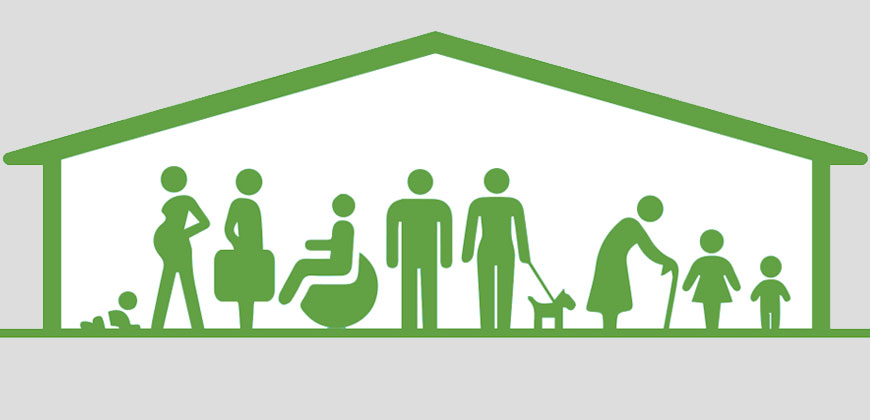
The term “Universal Design” is used for the design of products, services and environments that can be used by everyone.
In the case of physical environments, they should ideally meet the needs of every person who wishes to use them. This does not mean an exclusive space aimed at only a minority of the population. On the contrary, as the name suggests, “universal design” is founded precisely on universality.
That is exactly the fundamental principle of universal design: allowing products, services and environments to be used as independently and naturally as possible, in the greatest number of situations, without the need for adaptation, modification, assistive devices or specialized solutions.
How is Universal Design applied?
When using universal design to conceive a product, service or environment, the objective must be to include as many people as possible. If more than one option is available, the most inclusive one should be chosen.
For example: when installing door handles in a physical environment, lever handles should be preferred over knobs. A lever handle can be opened with an elbow or a closed fist, benefiting people carrying objects or with limited hand strength. Preference should likewise be given to single-lever faucets, operated by levers or by sensor.
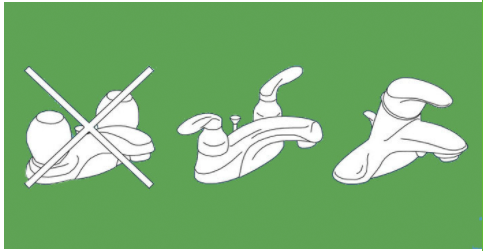
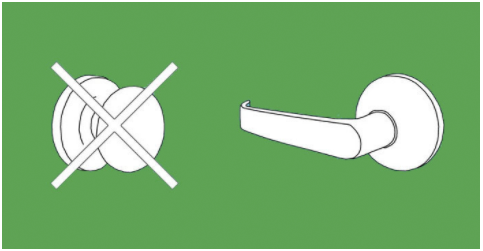
Lever, single-lever or sensor-operated handles and faucets make handling easier for people with limited hand strength or dexterity. Another example of application is building entrances with ramps or at grade. This is equally useful for someone moving furniture, pushing a stroller or using a wheelchair.
Universal design can increase the usability of an environment or product without representing a significant increase in cost. It is a solution that meets the needs of different stages of life, avoiding the need for later adaptations, when abilities or circumstances may have changed.
How does it relate to accessibility?
Universal design is centered on the human being and respects the different degrees of difficulty people experience when using a product, service or environment. In terms of that difficulty, user profiles can be as follows:
- Has no significant difficulties, but appreciates well-conceived, accessible and easy-to-use products, services or environments;
- Has little difficulty with all features;
- Has difficulty with some features;
- Has difficulty with most features;
- Is unable to use the features.
Therefore, if a design is well developed, taking accessibility and usability into account, people in any of these profiles will benefit.
Benefits of Universal Design for society
The age distribution of the world’s population is changing dramatically. As a result of developments in medicine and the adoption of healthier lifestyles, life expectancy has been increasing, which drives growth in the population over 65.
Advances in medicine also increase the life expectancy of people with physical, sensory, mental or intellectual disabilities, as well as severe or multiple disabilities.
Universal design provides benefits that make all the difference to the quality of life of this expanding population.
- Independent living: it allows people with different degrees of ability to live independently.
- Differences accommodated: people do not have the same abilities, and those abilities can vary according to internal or external factors.
Benefits of Universal Design for companies
Adopting universal design drives growth in potential markets and increases customer satisfaction, along with other benefits relevant to companies.
- Expanded market reach: An environment or product conceived on the basis of universal design parameters, and which can therefore be used by a greater number of people, means greater diversity among potential customers.
- Customer satisfaction and retention: a satisfied customer has the potential to act as a multiplier, recommending the service to other people who then become potential customers.
- Market crossover: design aimed at a particular audience can generate interest and demand in unexpected markets. For example, Oxo products were created with older people with arthritis in mind, but their design made them a hit with the general public.
- Positive public image: adopting universal design demonstrates that a company contributes positively to society, which adds to its reputation for a high level of corporate social responsibility.
- Compliance with legislation and standards: accessibility and usability are governed by specific legislation and by the definition of standards and guidelines. Universal design not only promotes compliance, but also has far greater potential to improve accessibility and ease of use beyond the minimum requirements set by law.
Get to know Guiaderodas Accessibility Certification
Learn about the Guiaderodas Accessibility Certification.The 7 Principles of Universal Design
The 7 Principles of Universal Design were developed in 1997 by a working group of architects, product designers, engineers and environmental design researchers at North Carolina State University.
Principle 1: Equitable use
The design can be used by people with different degrees of ability. For example:
- Doors with sensors that open automatically.
- Adaptable seating in venues such as sports arenas and theaters.
- Raising the roadway to sidewalk level at crossings, giving all pedestrians the same crossing conditions.
- Self-service equipment at heights within an ideal range of manual reach, allowing operation by people seated or standing.
Principle 2: Flexibility in use
The design accommodates a wide range of individual preferences and abilities. For example:
- Scissors that can be used with either hand.
- An ATM with visual, tactile and auditory feedback, a tapered card slot and a hand rest.
Principle 3: Simple and intuitive use
Use of the design is easy to understand, regardless of the user’s experience, knowledge, language skills or level of concentration. For example:
- A moving walkway or escalator in a public space.
- An instruction manual with drawings instead of text.
Principle 4: Perceptible information
The design communicates information effectively, regardless of environmental conditions or the user’s abilities. For example:
- Tactile, visual and auditory cues and instructions on a thermostat.
- Redundant signage in airports, train stations and subway stations (for example, voice and visual communication).
Principle 5: Tolerance for error
The design should minimize hazards and the adverse consequences of accidental or unintended actions. For example:
- A car key that can easily be inserted into the lock either way up.
- An “undo” feature in software programs that allows the user to correct a mistake without penalty.
Principle 6: Low physical effort
It can be used efficiently and comfortably and with minimum fatigue. For example:
- Lever door handles or single-lever faucets, operated by levers or by sensor.
- Touch lamps operated without a switch.
Principle 7: Size and space for approach and use
The environment or spatial element must have appropriate dimensions and space for approach, reach, manipulation and use, regardless of the user’s body size, posture or mobility. For example:
- Front-facing controls and sufficient space around appliances, mailboxes, bins and other elements.
- Subway station doors sized according to flow, so that they accommodate all users.
Make accessibility a decision, not a detail
Seven principles are the theory. A certification is the audit that shows whether they made it into your building.
The Guiaderodas Certification goes beyond a technical checklist. Its methodology combines a detailed assessment of the physical space, the lived experience of people with disabilities, staff training for an accessible attitude and a leadership commitment to continuous improvement.
Learn about the Guiaderodas Certification →