
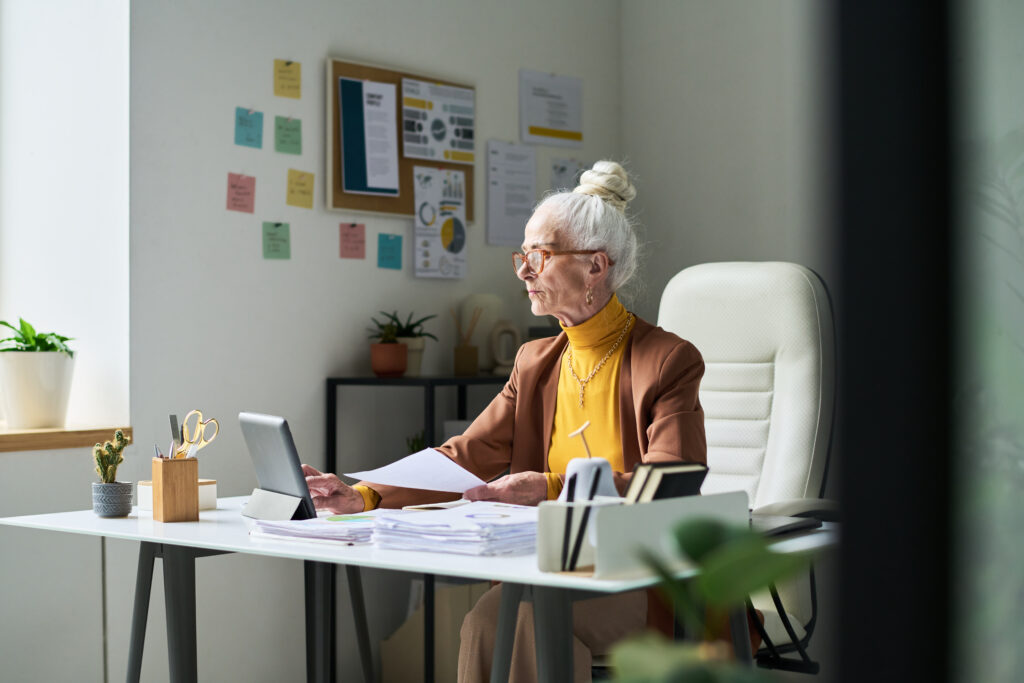
Population aging is one of the most predictable transformations of our time. And one of the least incorporated into the design and management of spaces.
According to projections announced in 2024 at the World Economic Forum, by 2050 people aged 50 and over will represent 30% of the global workforce. In Brazil, that group already accounts for roughly 25% of active professionals, the equivalent of more than 23 million people.
What changes in the relationship with space
Aging affects visual perception, hearing acuity, reaction time, balance and tolerance for environments with excessive stimuli. These changes do not happen uniformly or on set dates, but accumulate gradually and alter what a space needs to offer in order to remain usable with autonomy.
Perceiving level changes depends on adequate lighting and visual contrast at the edges of steps and level transitions. Insufficient lighting, or lighting with sharp contrasts between light and dark, which would merely be uncomfortable for a young adult, can represent a real risk of falling for an older person.
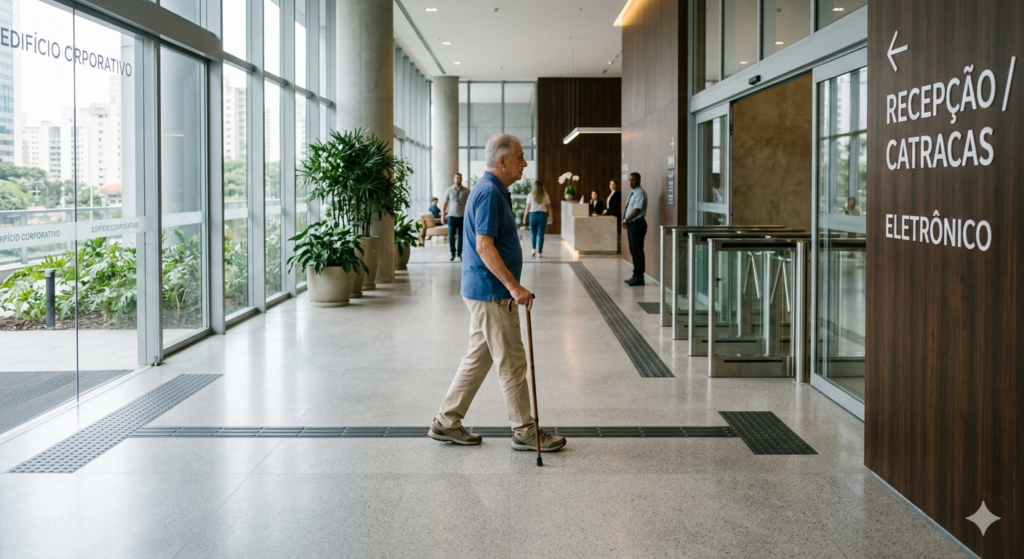
Travel time changes too. Access control systems calibrated for an average passage speed may close before a person completes the crossing. Turnstiles, automatic doors and lifts need to account for the fact that different people move at different paces.
Signage legibility depends on typography, contrast and size that work for those with reduced visual acuity. A sign well designed for an adult with full vision may be illegible for someone aged 65 in a poorly lit environment.
Accessibility as a response to aging
The accessibility features that benefit people with disabilities are, to a large extent, the same ones that benefit older people. Firm and even flooring, uniform lighting, handrails on both sides with a good grip, legible signage, access control systems with adequate passage time, furniture at heights suited to different user profiles.
This is the natural consequence of designing with the human being at the center, in all their anthropometric, sensory and cognitive diversity. If a design considers a broader range of user profiles, the result is a space that works better for everyone.
What this means for those who design and manage spaces
The relevant question is not whether spaces will need to adapt to an aging population. They will. The question is when that adaptation will happen: at design stage, where the cost of change is lower and the result is better integrated, or as a retrofit, where the options are more expensive and more limited.
Brazil’s Statute of the Older Person, the Brazilian Inclusion Act and the technical accessibility standards already recognize this need. But beyond the legal aspect, there is a practical and strategic dimension. Companies and spaces that welcome older people well today are preparing their infrastructure for the user profile that will dominate the coming decades.
Well-executed accessibility is not preparation for a hypothetical future, but the response to a reality that has already arrived.
Make accessibility a decision, not a detail
Learn about the Guiaderodas Certification →
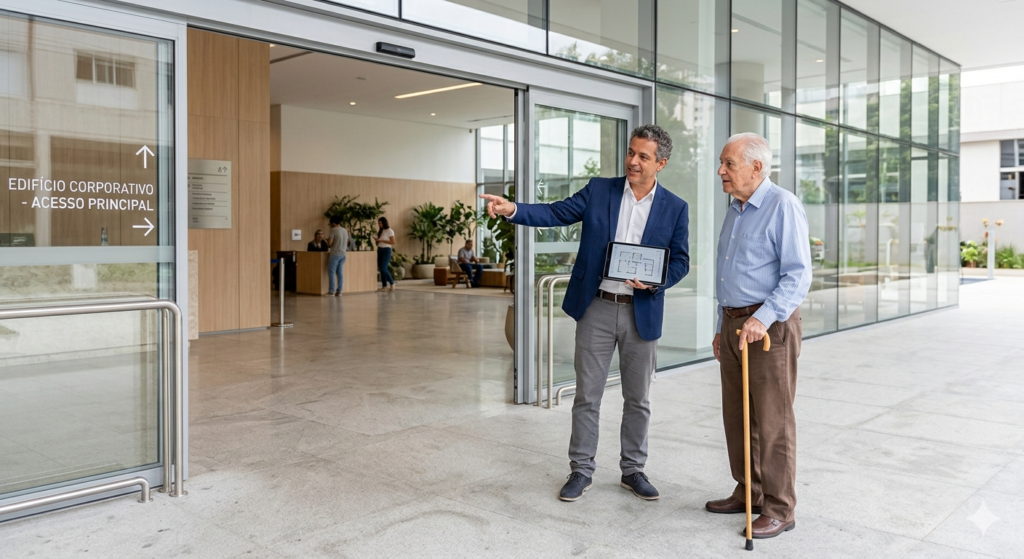
The user profile of the next decades is already walking through your doors. The question is whether your space is ready for them.
The Guiaderodas Certification goes beyond a technical checklist. Its methodology combines a detailed assessment of the physical space, the lived experience of people with disabilities, staff training for an accessible attitude and a leadership commitment to continuous improvement.