
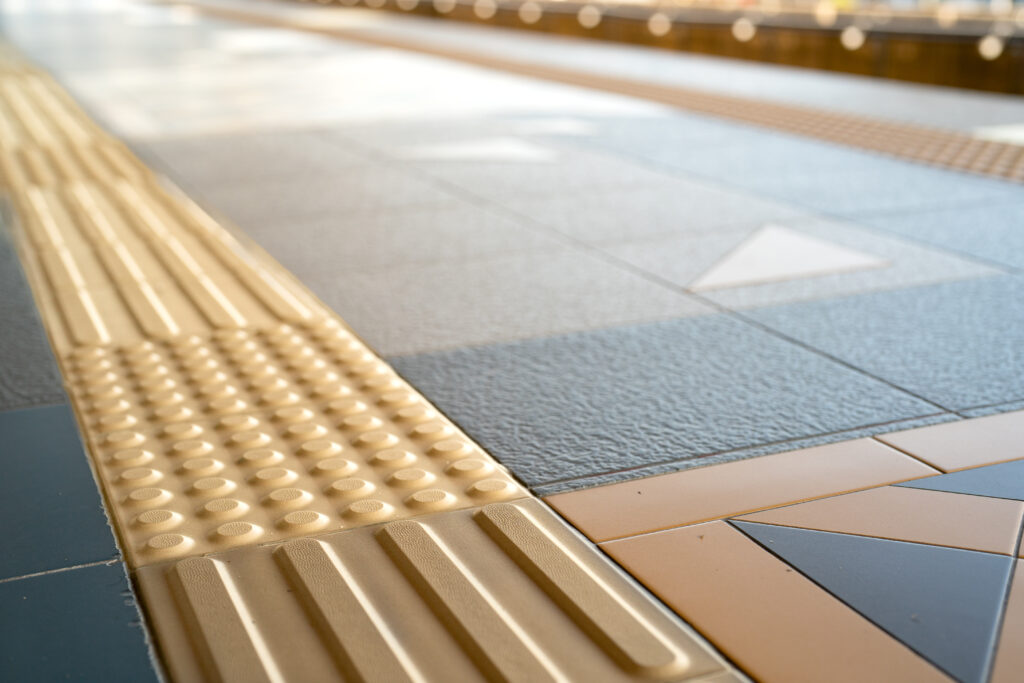
There is an apparent logic to installing more tactile paving in order to make a space more accessible. More guidance, more safety. In practice, that logic frequently fails.
Tactile paving is a complementary resource for orientation and safety. When applied beyond what is necessary, or without being coordinated with the space where it is being installed, it undermines the very function it exists for: guiding the user clearly and safely.
What tactile paving needs to do
A tactile ground surface indicator scheme must be conceived as a continuous, integrated system of orientation. That means it needs to guide a person from the point of arrival to the final destination, or to places where information can be obtained, such as a reception desk. To fulfill that role, the elements must be legible and organized according to a coherent spatial logic, in coordination with the other components of the environment.
A system that leads to no clear destination, that breaks off midway or that multiplies without criteria is not a system. It is material installed on the floor with no defined function.

What happens when there is too much
Excessive, discontinuous or inadequate use of tactile paving can undermine its function, creating ambiguity in the reading of the space and making the route harder to understand. For those who depend on this system as a reference for orientation, encountering routes that cross each other without logic, or that cover large areas without indicating direction, means interpreting the environment instead of navigating it.
There is also an effect that is rarely considered at installation: the impact on people who use wheelchairs, strollers or walkers. Tactile paving in disproportionate quantities can directly interfere with the movement of this equipment, making the route more difficult.
ABNT NBR 16537, the standard governing tactile ground surface indicators, is direct on this point: the application must be precise and coherent with the space, avoiding excesses or inadequate positioning that could confuse the user, put their safety at risk or compromise the reading of the environment.
The question of trust
There is an aspect that goes beyond immediate usability. An inadequate application can be more harmful than the absence of the resource, because it undermines the user’s trust in the system.
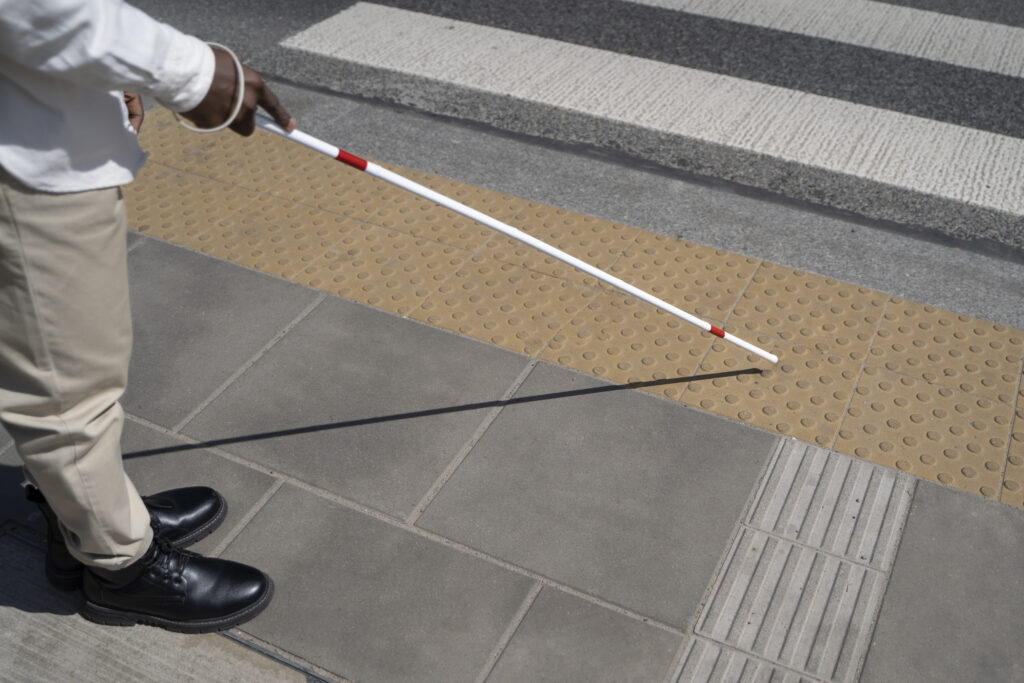
People who use tactile paving as an orientation reference learn to trust it. When the paving leads to a dead end, when it is interrupted, or when it is covered by a mat or blocked by furniture, the consequence is not merely momentary disorientation. It is the loss of the predictability that made the space navigable.
Predictability is one of the central principles of accessibility. A predictable environment is a safe environment. An orientation system that does not behave consistently contradicts that principle regardless of how much material has been installed.
Where excess appears most often
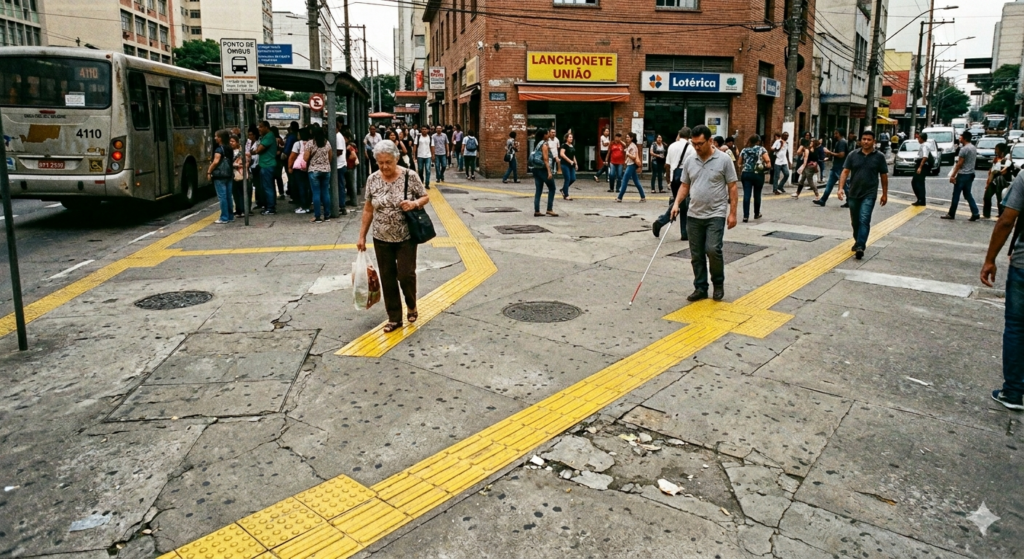
On sidewalks, it is common to find tactile paving on narrow walkways, with no distinction between the circulation strip and the service strip, and with no relationship to the real decision points along the route. In lobbies and reception areas, the paving frequently multiplies to create an appearance of accessibility without any functional route behind it.
In corporate offices, the application of tactile paving often fails to consider that employees with visual impairments develop mental maps from everyday experience and use architectural references to move around. In these cases, an excess of tactile paving does not aid orientation and may even hinder the movement of people who use wheelchairs.
How to assess before installing
The question that guides a functional tactile paving scheme is a direct one: does this route take someone somewhere?
The application must consider the real circulation flows, the points where orientation is needed, the potential risks and the other interferences in the space. That includes checking whether doormats or rugs at the entrance overlap the route, whether furniture or equipment interrupts continuity, and whether the visual contrast between the tactile paving and the adjacent flooring is sufficient to guide people with low vision as well.
Installing less, with more judgment, produces a system that is more legible and more trustworthy than covering the floor in the hope that quantity will make up for planning.
Make accessibility a decision, not a detail
More tactile paving is not more accessibility. Precision is.
The Guiaderodas Certification goes beyond a technical checklist. Its methodology combines a detailed assessment of the physical space, the lived experience of people with disabilities, staff training for an accessible attitude and a leadership commitment to continuous improvement.
Learn about the Guiaderodas Certification →